
EV chargers
Level 2 home EV chargers for Front Range homes, installed with a look at your electrical panel first, and paired with solar and a battery when you have them.
Written price before work starts
The price depends on the distance from your panel to the charger, the circuit needed and whether the panel has room.
Good fit if
- You drive an EV and want faster charging at home
- You have solar or are adding it
- You are not sure your panel can take another big circuit
- You want the charger, solar and battery to work together
Who is this for?
If you drive an electric car and want it charged faster at home, a Level 2 charger is the usual answer. We install Level 2 chargers on a dedicated 240-volt circuit, check your electrical panel before we quote, and set the charger up to work alongside your solar and battery. This page is part of our solar hub.
Do you need Level 2, or will a regular outlet do?
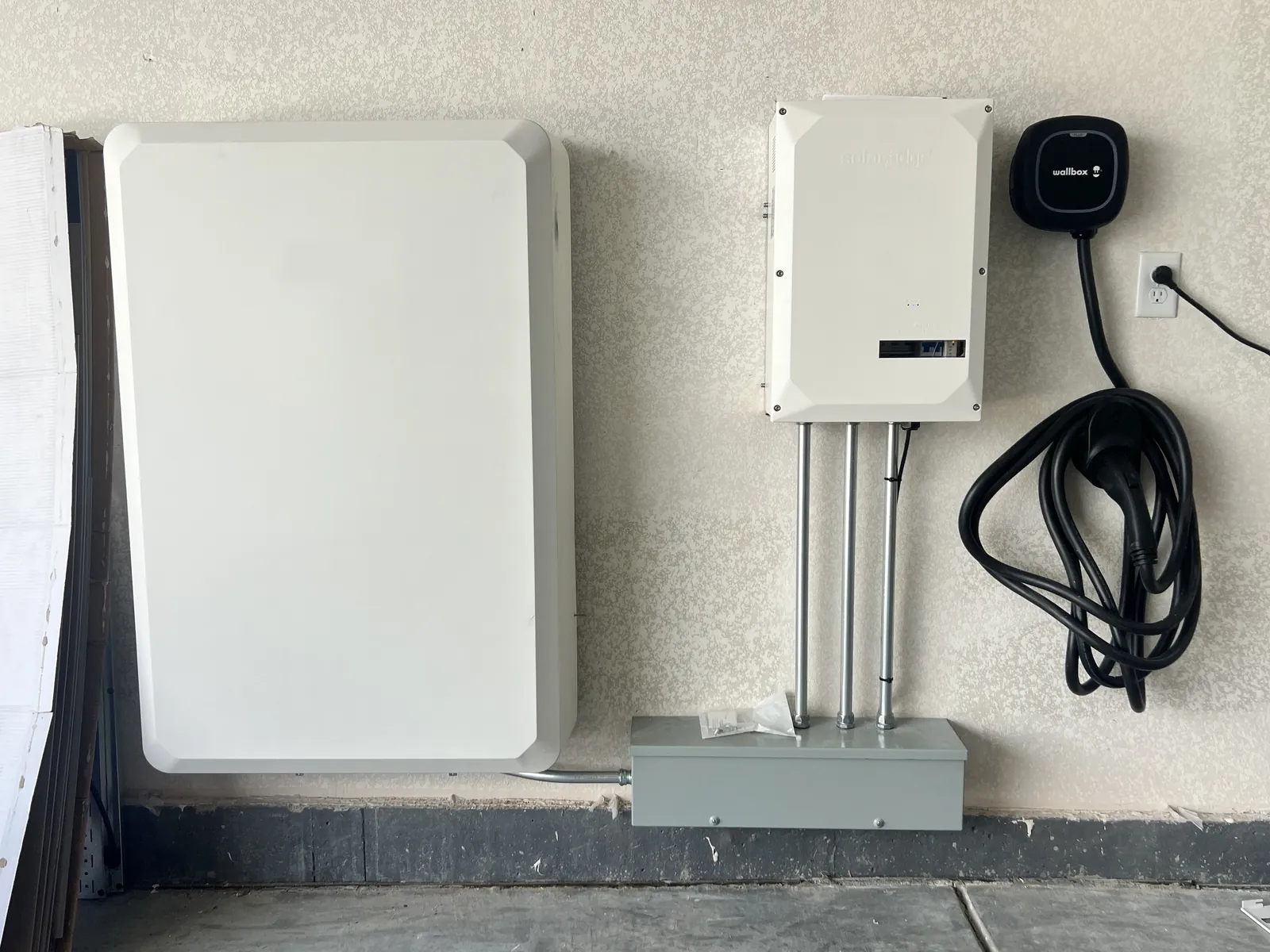
That question has its own home: what all the solar equipment on your garage wall is answers it in full, along with what the battery, inverter and junction box do. The short version: a regular outlet works for short daily driving, and Level 2 is for longer commutes or when you need a full charge overnight.
Will your electrical panel handle it?
A Level 2 charger is one of the biggest loads in a house, often as big as an electric range. Whether your panel can take it depends on its size and what is already on it: an electric furnace or heat pump, a range, a dryer, a hot tub, a battery system. Before we quote, we look at all of it.
There are usually three outcomes:
- There is room. We add the circuit and mount the charger.
- It is tight. Some chargers can be set to a lower current, or a load-management device can share capacity with another big load.
- It needs more capacity. A panel or service upgrade comes first. That involves the utility, so it takes longer.
We tell you which one applies, in writing, before any work starts.
How does a charger work with solar?
Solar powers the house first, and the charger is one more load in the house. When you charge during the day, more of that charge comes from your roof. If you work days and charge at night, a home battery can store some daytime solar for the evening, though a car can use a lot of a home battery's stored power in one session.
For the full picture of where the power goes on a sunny day, in the evening and in an outage, see the diagram on the home batteries page.
What about outages?
During an outage, a battery runs the circuits you chose. Most people do not put the EV charger on that list, because it would drain the battery quickly. The answer page on whether solar works during a power outage covers why solar alone shuts off and what a battery changes.
Do you install chargers without solar?
With or without solar, ask us. Call or send a request and tell us what you have at home, and we will tell you what we can do.
What about Colorado winters?
Cold weather cuts an EV's range and slows charging, so a charger at home matters more in January than in June. The charger itself mounts inside the garage in most homes. Outdoor installs need a unit and wiring rated for outdoor use, and we plan for snow and the driveway.
What do you get in writing?
The circuit, the charger location, any panel work and a written price before work starts. Our workmanship warranty is 10 years, in writing. Battery and charger warranties come from the manufacturer and depend on the product.
How it works
From first call to finished job.
- 01
Panel check
We look at your electrical panel's size, what is already on it and where the charger would go.
- 02
Written proposal
You get the circuit, the charger location, any panel work and the price in writing.
- 03
Install and inspect
We run the 240-volt circuit, mount the charger and the city or county inspects the work.
Questions about ev chargers
Do you install EV chargers for homes without solar?
With or without solar, ask us. Tell us what you have and we will tell you whether we can do the job and what it involves.
Can my solar panels charge my car?
Yes, in the sense that solar power runs the house, and the charger is part of the house. If you charge during the day, more of that power comes from the roof. A battery can also store daytime solar for evening charging.
Where should the charger go in my garage?
Close to where the car's charging port ends up when you park, and as close to the electrical panel as practical, since a shorter run is simpler. We work out the spot with you on the visit.
Should the EV charger be on battery backup during an outage?
Usually not. A car can drain a home battery fast, so most people leave the charger off the backed-up circuits and keep the battery for the fridge, heat and lights.
Answers on this site are general information about roofing and solar in Colorado, not legal, tax or insurance advice. Programs, codes and utility rules change; your written proposal and your insurer or utility have the final word.
Keep exploring
Related services
- SolarEverything in solar
- Commercial solarSolar for business and building owners on the Front Range, on the roof, over the parking lot or over the fuel pumps. We design it, permit it, install it and get it approved by the utility.
- Home solarRooftop solar for homeowners in the Denver metro and Front Range, designed around your roof, your shade, your electrical panel and the fire code. We also do the roof, so we tell you if it needs replacing first.
- Home batteriesA home battery stores solar power for the evening and keeps the circuits you choose running when the grid goes down. We install batteries with new solar and add them to systems already on the roof across the Front Range.
Answers to read first
Where we do this
Tell us about the roof, the panels or the building.
Send the form or call. We set up an assessment, then send a written proposal with the scope and the price.
Monday–Friday 9 a.m.–5 p.m.